
Reynolds Number in Flow Measurement and Conditioning
Reynolds number plays a critical role in determining flow behaviour, directly impacting flow measurement accuracy, system performance and instrumentation selection.

Over 45 Years in Operation

1000's of UK Installations

Supporting 100's of UK Sites





Accurate flow measurement depends not only on the flow meter itself, but also on the behaviour of the fluid within the pipe. One of the most important factors in understanding this behaviour is the Reynolds number.
Reynolds number defines whether flow is laminar, transitional or turbulent, and this has a direct impact on measurement accuracy, repeatability and system performance.
In many industrial applications, poor understanding of flow regime leads to incorrect meter selection, unstable readings or reduced accuracy. By understanding Reynolds number and how it affects flow, operators can ensure reliable measurement and better process control.
The Problem
Flow measurement systems are often installed without full consideration of flow regime, leading to performance issues.
Common challenges include:
- Laminar or transitional flow reducing measurement accuracy
- Unstable or non-repeatable readings due to changing flow conditions
- Incorrect meter selection for the operating flow regime
- Distorted flow profiles caused by pipework and fittings
- Inadequate straight pipe lengths affecting flow development
- Poor system performance in low flow or viscous applications
Without understanding Reynolds number, it becomes difficult to predict how a flow meter will perform in real-world conditions.

The Solution
Understanding and accounting for Reynolds number allows for better selection and installation of flow measurement technologies.
In many cases, flow conditioning is used to stabilise the flow profile and improve measurement performance, particularly where installation constraints exist. Solutions such as VORTAB Flow Conditioners can help ensure a uniform velocity profile, even in systems with disturbed or undeveloped flow.
This approach is widely used across applications such as Combustion Air Flow Measurement, Biogas Flow Measurement and Flare Gas Metering Using Thermal Mass Flow Measurement, where flow conditions are rarely ideal.
By combining correct flow regime understanding with appropriate instrumentation and installation, operators can significantly improve measurement reliability.
Technical Insight
What is Reynolds number?
Reynolds number (Re) is a dimensionless value used to predict flow behaviour. It represents the ratio of inertial forces to viscous forces within a fluid.
Reynolds number formula
Re = (ρ × v × D) / μ
Where:
- ρ = fluid density
- v = velocity
- D = pipe diameter
- μ = dynamic viscosity
Flow regimes
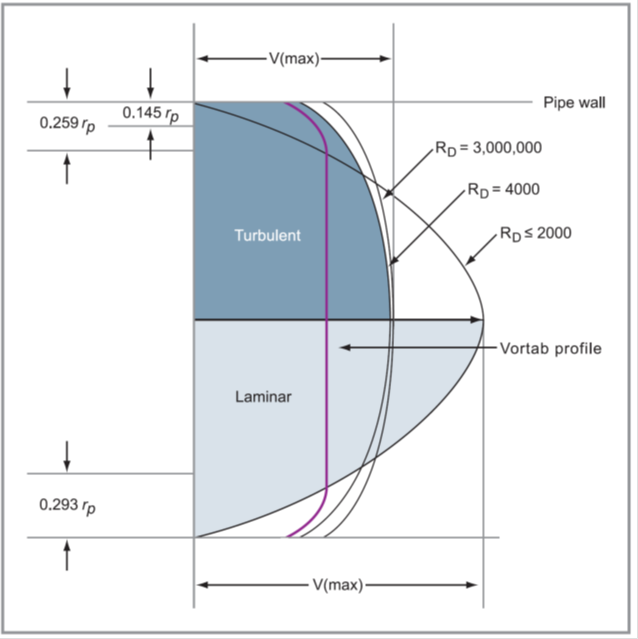
- Laminar flow (Re < ~2,000)
Smooth, ordered flow with minimal mixing
Often found in low velocity or high viscosity applications - Transitional flow (Re ~2,000–4,000)
Unstable flow that can fluctuate between laminar and turbulent - Turbulent flow (Re > ~4,000)
Chaotic, well-mixed flow with eddies and velocity fluctuations
Preferred for most industrial flow measurement applications
Why it matters for flow measurement
Most flow meters are designed to operate in turbulent flow conditions. Laminar or transitional flow can result in:
- Reduced accuracy
- Poor repeatability
- Increased sensitivity to installation conditions
Flow profile development
In addition to Reynolds number, flow profile is influenced by upstream disturbances such as elbows, valves and compressors.
This is where flow conditioning becomes critical, particularly in systems with limited straight pipe runs.
Recommended Products
VORTAB Flow Conditioners
Used to stabilise flow profiles and improve measurement accuracy in disturbed or constrained installations.
Thermal Mass Flow Meters
Provide reliable measurement across a wide range of flow conditions, particularly in gas applications.
Key Benefits
- Improved understanding of flow behaviour and measurement performance
- Better selection of flow measurement technologies
- Increased accuracy and repeatability in real-world installations
- Reduced impact of installation constraints and flow disturbances
- Enhanced process control and system efficiency
- Supports optimisation across gas, liquid and air systems
Need information or advice?
Speak with our friendly, expert team to discuss your requirements and find out how we can help you.
Reynolds Number & Flow Measurement FAQs
Explore common questions about Reynolds number, flow regimes and how they impact flow measurement accuracy and system performance.
What is Reynolds number in simple terms?
Reynolds number is a way of predicting how a fluid will behave in a pipe, whether it flows smoothly (laminar) or turbulently. This directly affects how accurately flow can be measured.
Why is turbulent flow preferred for flow measurement?
From experience, turbulent flow provides a more stable and predictable velocity profile, which allows flow meters to perform at their specified accuracy. Laminar flow can lead to inconsistent and less reliable readings.
What happens if flow is laminar?
Laminar flow results in a parabolic velocity profile, meaning fluid moves faster in the centre of the pipe than at the edges. This can reduce measurement accuracy, particularly for certain flow technologies.
How do flow conditioners help?
Flow conditioners stabilise the flow profile, removing swirl and asymmetry caused by upstream disturbances. This helps ensure the flow meter sees a consistent and predictable flow profile.
Can Reynolds number change during operation?
Yes. Changes in flow rate, temperature, pressure or fluid properties can all affect Reynolds number, meaning flow regime can change during operation.
Do all flow meters require turbulent flow?
Not all, but most industrial flow meters perform best in turbulent conditions. Some technologies are more tolerant than others, but understanding flow regime is always important when selecting instrumentation.
Relevant Links

Why Trust Allison Engineering
We are committed to delivering the highest standards across the specialist areas we support, combining proven products with practical engineering knowledge and dependable service.
Need Help Improving Flow Measurement Accuracy?
Speak to our team to review your application, understand your flow conditions and select the right solution to ensure accurate, reliable measurement.